
Decoding the Digital Dialogue: Understanding the Psychology of Online Communication
The digital revolution has fundamentally altered how we communicate, creating new psychological dynamics that shape our online interactions. As digital communication becomes increasingly integral to daily life, understanding its psychological underpinnings becomes essential for navigating our connected world effectively. This article explores the psychological mechanisms behind digital communication and how they influence our behavior, relationships, and well-being in the virtual realm.
Instant Connections, Real Emotions
Despite the immediacy of digital communication, research reveals significant differences in emotional connectedness between online and in-person interactions. Studies consistently show that text-based methods like instant messaging result in measurably lower levels of emotional bonding compared to face-to-face interactions, particularly among close friends in emerging adulthood.
Research published in the Journal of Cyberpsychology demonstrates that while digital communication offers convenience, it often lacks the emotional depth of in-person exchanges. Interestingly, the emotional impact varies by medium—phone calls tend to foster greater bonding for frequent users compared to text-based communication, though still not matching face-to-face interaction.
To compensate for this emotional deficit, users have developed adaptive strategies through what researchers call “digital affiliation cues”:

- Emoticons and emojis to convey facial expressions
- Typed laughter (e.g., “haha,” “lol”) to simulate shared humor
- Strategic capitalization to indicate emphasis or excitement
- Extended punctuation to reflect tone and emotion
These textual adaptations align with social information processing theory, which suggests that individuals become more adept at utilizing communication tools with experience. However, meta-analyses of digital communication media indicate that while these cues enhance emotional connectedness in text-based exchanges, they rarely match the psychological impact of physical presence.
The question “How does digital communication affect mental health?” becomes increasingly relevant as we consider these emotional differences. The impact varies significantly based on individual usage patterns, communication purposes, and personal predispositions.
Behind the Screen: The Online Disinhibition Effect
One of the most documented phenomena in cyberpsychology is the online disinhibition effect—the tendency for people to behave differently online than they would in person. This psychological mechanism helps explain why individuals might appear more generous, emotionally expressive, uncaring, or even hostile in digital environments.
According to John R. Suler’s work on the psychology of the digital age, this disinhibition stems from several key factors:
- Dissociative anonymity: The perception that online actions are separate from offline identity
- Invisibility: The absence of physical presence and visual cues
- Asynchronicity: The time lag between responses that removes immediate reactions
- Solipsistic introjection: The tendency to project personalities onto digital communications
- Minimization of authority: Reduced impact of traditional status indicators
The concept of digital identity plays a crucial role in this phenomenon. Users often carefully tailor online personas for various purposes—idealization, anonymity, or role-playing—creating what can be multiple versions of self that exist simultaneously across different platforms.
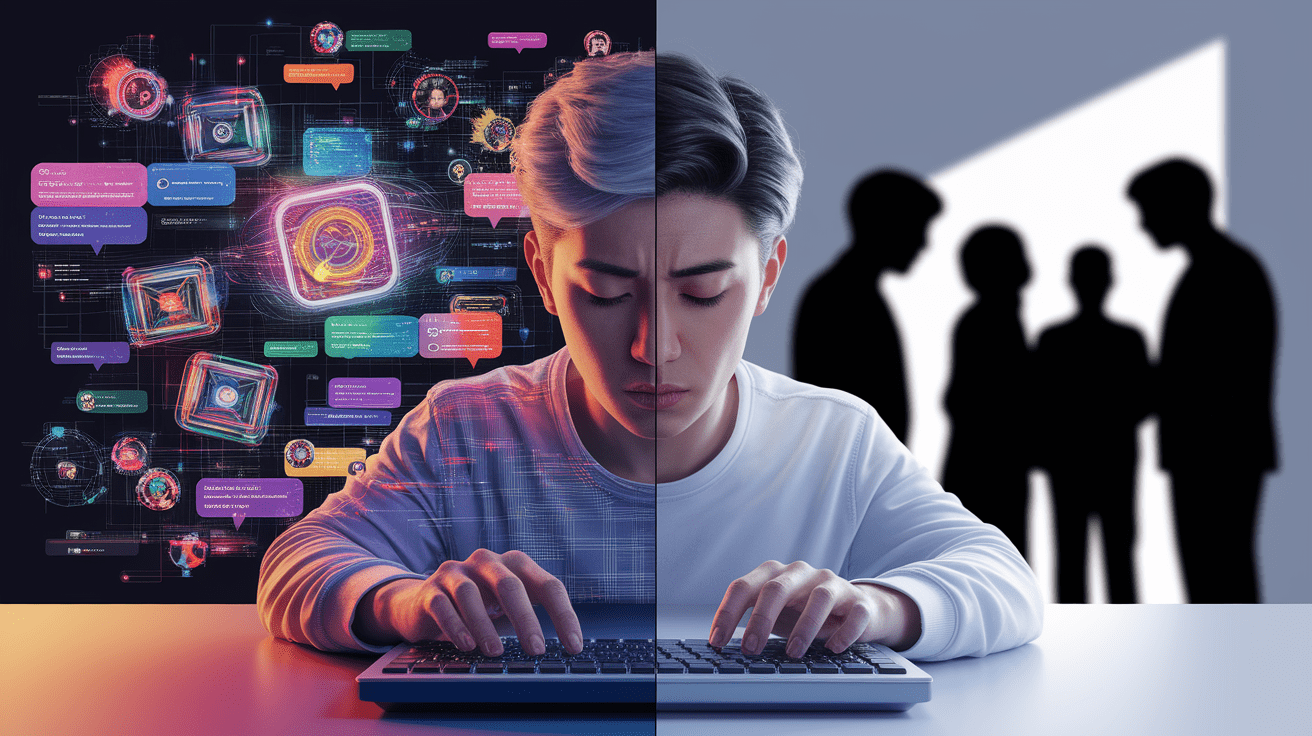
Sherry Turkle, a prominent researcher in this field, notes that these digital identities aren’t merely false representations but complex psychological extensions of ourselves adapted to different digital environments. This multiplicity of identity can have both liberating and potentially dissociating effects on psychological well-being.
The reduced sensory experience of digital communication—lacking physical cues like body language, facial expressions, and tone of voice—fundamentally alters social norms and interaction patterns. This sensory limitation creates a psychological distance that can simultaneously foster deeper self-disclosure and reduce empathetic responses, explaining both the profound connections and troubling behaviors that characterize online communication.
Social Networks: The New Socialization Hub
Digital technologies have revolutionized interpersonal communication, with social networks emerging as primary socialization spaces, particularly among younger generations. Research on digital socialization patterns reveals that social networking platforms now play an instrumental role in how undergraduate students build and maintain relationships, influencing their communication styles, social development, and psychological well-being.
The motivations driving social network engagement reveal important psychological dynamics:
- Pleasure and enjoyment: The intrinsic reward of engaging content and interactions
- Affection and gratitude: Expressing appreciation and maintaining emotional connections
- Inclusive sharing: Building community through shared experiences and information
- Escape: Temporary psychological relief from stress or daily pressures
- Relaxation: Using digital spaces as environments for unwinding
- Control: Managing self-presentation and information disclosure
These motivations correlate with specific personality traits and communication styles. For instance, individuals with an external locus of control—who believe external factors primarily determine outcomes—tend to show stronger escape and control motivations in their online interactions.

Psychological research on social media interactions indicates that these platforms create unique behavioral patterns that wouldn’t exist in traditional communication contexts. The constant feedback loops of notifications, likes, and comments trigger dopamine-driven reward cycles that can significantly influence behavior and self-perception.
Understanding “the psychological impact of social media on teenagers” becomes particularly important as we recognize that these platforms often serve as primary socialization environments during critical developmental periods, potentially shaping identity formation, communication skills, and relationship expectations in lasting ways.
The Chameleon Effect: Mimicry in Digital Communication
A fascinating aspect of digital communication psychology is the digital manifestation of the chameleon effect—the unconscious tendency to mimic the behavior of others during social interaction. In face-to-face settings, this often involves matching postures, gestures, or speech patterns. In digital environments, it transforms into mirroring conversational cues, linguistic patterns, and emoji usage.
Studies on social psychology in digital communication demonstrate that this digital mimicry serves similar social functions to its physical counterpart. When people mirror conversational cues—adopting similar response timing, emoji use, or writing style—they typically experience increased likability and rapport, even without physical presence.
This digital chameleon effect appears to leverage the same neurological mechanisms that evolved for face-to-face social bonding:
- Activation of mirror neurons that support empathy and understanding
- Release of oxytocin that promotes trust and bonding
- Enhanced neural synchronization between communicating individuals
The neurological impact extends to expectation management in digital exchanges. When mismatches occur between expected and actual responses—such as delayed replies or unexpected tone—the brain triggers instinctive responses similar to in-person social disappointments, releasing stress hormones that can color perceptions and future interactions.
This neurological dimension helps explain why “exploring the psychology behind online dating and relationships” reveals complex emotional responses that mirror traditional relationship dynamics despite occurring in virtual spaces. The brain processes digital social cues using many of the same mechanisms evolved for in-person interaction, creating genuine emotional experiences even through screens.
Understanding these processes offers valuable insights for “strategies for maintaining healthy digital communication habits.” Successful digital exchanges create positive neurochemical rewards through dopamine release, reinforcing communication patterns and platform usage, while negative experiences can create lasting aversions to specific digital communication channels or styles.
Conclusion: Navigating the Digital Landscape
The psychology of digital communication represents a complex intersection of evolutionary social tendencies and novel technological contexts. As we’ve explored, our brains process digital interactions using mechanisms developed for face-to-face communication, creating both opportunities and challenges in how we connect online.

Understanding these psychological dimensions offers several important insights:
- Digital communication provides unprecedented connectivity but often with reduced emotional depth
- Online environments can significantly alter behavior through disinhibition effects
- Social networks have become critical socialization hubs with unique psychological dynamics
- Digital mimicry serves important social functions similar to physical mirroring
- Neurological responses to digital communication create real emotional impacts
As digital communication continues to evolve, developing awareness of these psychological mechanisms becomes increasingly important for maintaining healthy online interactions and relationships. By recognizing both the limitations and unique possibilities of digital communication, we can approach our online exchanges with greater intentionality, empathy, and effectiveness.