Unlocking Creativity: The Neuroscience Behind Innovative Thinking
Creative thinking represents one of humanity’s most valuable cognitive abilities, yet its underlying neural mechanisms have remained elusive until recent advances in neuroscience. Today, researchers are uncovering the intricate brain processes that give rise to our moments of innovation, insight, and imagination.
The Brain’s Creative Symphony
Creative cognition doesn’t emerge from a single brain region but rather from the coordinated interplay of multiple neural networks. Research has identified three primary brain networks that work together in a delicate balance during creative processes:
- Default Mode Network (DMN): This network activates during spontaneous thinking, mind-wandering, and imagination—crucial elements of creative ideation. The DMN supports the generation of novel ideas and is linked to both memory recall and future envisioning through connections with the hippocampus. When you’re daydreaming or letting your mind wander freely, your default network is likely highly active.
- Executive Control Network (ECN): This network handles the more deliberate aspects of creativity—focused evaluation, refinement of ideas, and goal-directed processing. The ECN typically deactivates when the default network is active, representing the natural tension between spontaneous and controlled creative processes.
- Salience Network: Acting as a critical switch between the other two networks, the salience network enables their cooperation during creative tasks. It helps determine which ideas warrant further attention and elaboration.
Research using functional MRI during divergent thinking tasks consistently shows that stronger connectivity between these networks predicts higher creativity scores. This finding challenges the older view that creativity stems solely from “right-brain” activity, revealing instead that innovative thinking emerges from coordinated activity across the entire brain.
The dynamic shifting between spontaneous idea generation and focused evaluation represents what neuroscientists call the “creative cognition cycle.” During this cycle, the brain alternates between generative and evaluative modes, allowing for both the production of novel ideas and their critical assessment.
The Prefrontal Cortex: The Creative Conductor
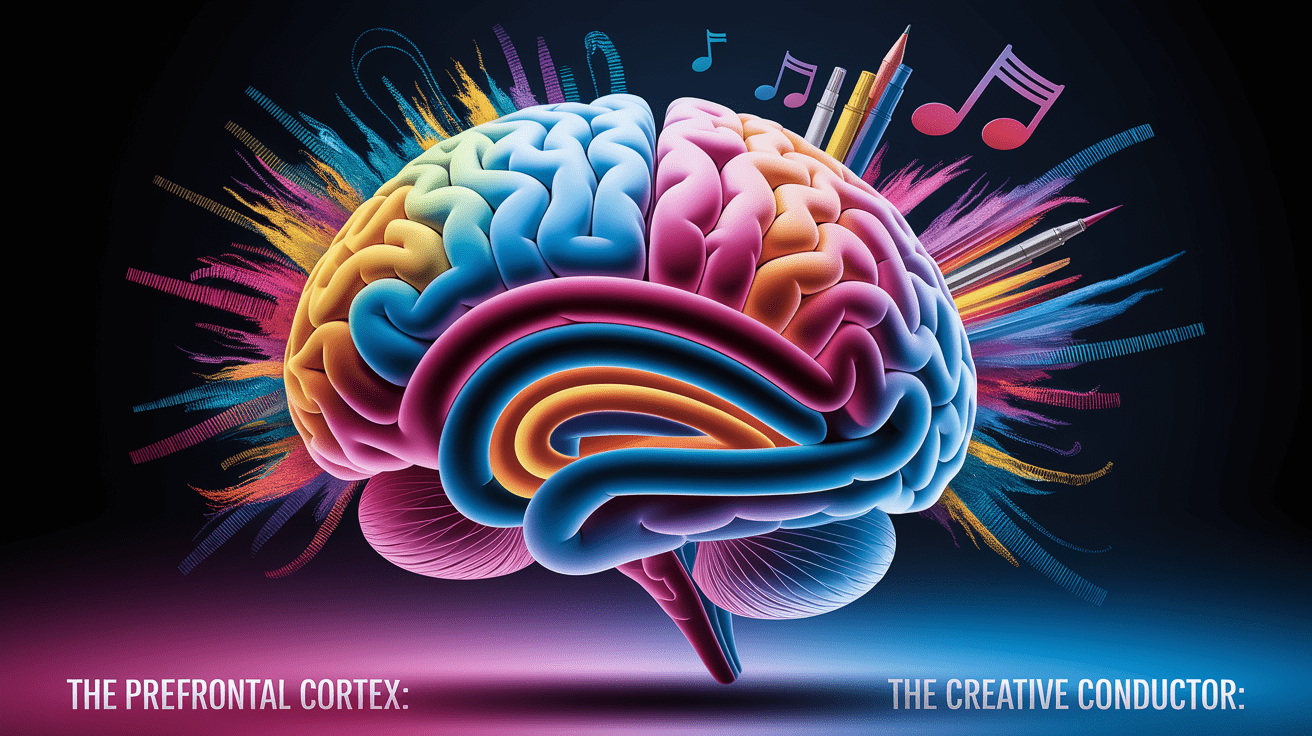
While creativity involves multiple brain regions working in concert, the prefrontal cortex (PFC) acts as a central hub or conductor of this neural symphony. Located at the front of the brain, the PFC manages several critical functions essential for creative thinking:
- Working Memory: Maintains and manipulates information during creative problem-solving
- Conscious Awareness: Brings novel connections and insights into conscious awareness
- Inhibitory Control: Suppresses obvious or irrelevant thoughts to allow novel combinations
- Executive Functions: Directs attention and supports abstract reasoning
The frontopolar cortex, the most anterior part of the PFC, appears particularly important for creative cognition. This region helps evaluate the appropriateness of insights and integrates information from temporal, occipital, and parietal regions. Researchers have observed that damage to the prefrontal cortex often results in diminished creative output, highlighting its necessity for both spontaneous and controlled creative processes.
Studies using brain imaging technology reveal that the PFC doesn’t work in isolation but coordinates activity across distributed brain regions. This coordination becomes especially evident during tasks requiring cognitive flexibility and originality—hallmarks of creative thinking. The PFC helps break mental sets and overcome cognitive fixation, allowing for the novel recombinations of ideas that characterize creative breakthroughs.
Memory and Imagination: The Hippocampus Connection
The relationship between memory and creativity represents one of the most fascinating aspects of creative cognition. The hippocampus, located within the medial temporal lobe and part of the brain’s default network, serves as a critical nexus between past experiences and new ideas.
Research shows that the hippocampus supports creative idea generation through two related processes:
- Episodic Memory Recall: Drawing on personal past experiences to inform new thinking
- Episodic Future Imagination: Constructing and simulating novel scenarios that have never occurred
These processes share neural substrates, explaining why remembering the past facilitates the creation of novel combinations and the envisioning of scenarios that have never existed. Studies employing episodic induction techniques—prompting individuals to think about specific personal memories before creative tasks—show increased hippocampal activity and enhanced creative performance.
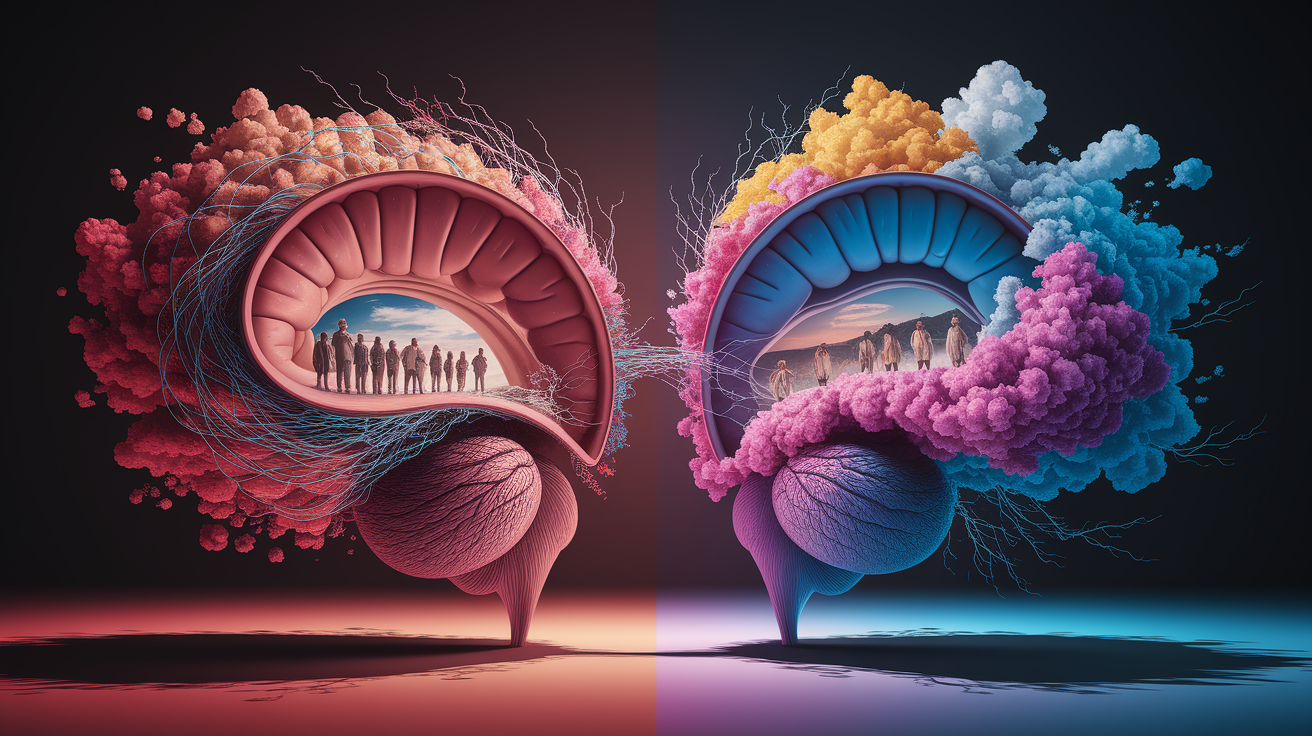
The hippocampus’s role in creative thinking aligns with the concept of “constructive episodic simulation,” where elements of memory are flexibly recombined to generate new ideas. This process helps explain why individuals with rich episodic memory systems often demonstrate enhanced creative abilities, as they have more raw material from which to construct novel combinations.
Functional MRI evidence confirms heightened connectivity between the hippocampus and other regions during creative tasks, particularly when generating original ideas. This network connectivity represents the neural basis for the long-observed connection between memory and imagination in creative thought.
Neurotransmitters: The Chemical Pathways to Creativity
The brain’s chemical messengers—neurotransmitters—play crucial roles in modulating creative cognition. Three key neuromodulators have been particularly linked to different aspects of the creative process:
- Dopamine (DA): Associated with cognitive flexibility, motivation, and reward processing, dopamine helps reduce cognitive fixation and enhances divergent thinking—the ability to generate multiple solutions to a problem. The dopaminergic system supports the exploration of new ideas and cognitive flexibility.
- Noradrenaline (NE): This neurotransmitter helps regulate attention and arousal levels, which influences the persistence pathway of creativity. At moderate levels, noradrenaline facilitates focused creative work.
- Serotonin (5-HT): While less studied in direct relation to creativity, serotonin affects mood regulation, which can indirectly impact creative performance by influencing emotional states.
Researchers have proposed that these neurotransmitters influence creative cognition through two complementary pathways: flexibility and persistence. The flexibility pathway enhances divergent thinking by reducing cognitive fixation, while the persistence pathway supports convergent creativity through sustained, effortful exploration of possibilities.
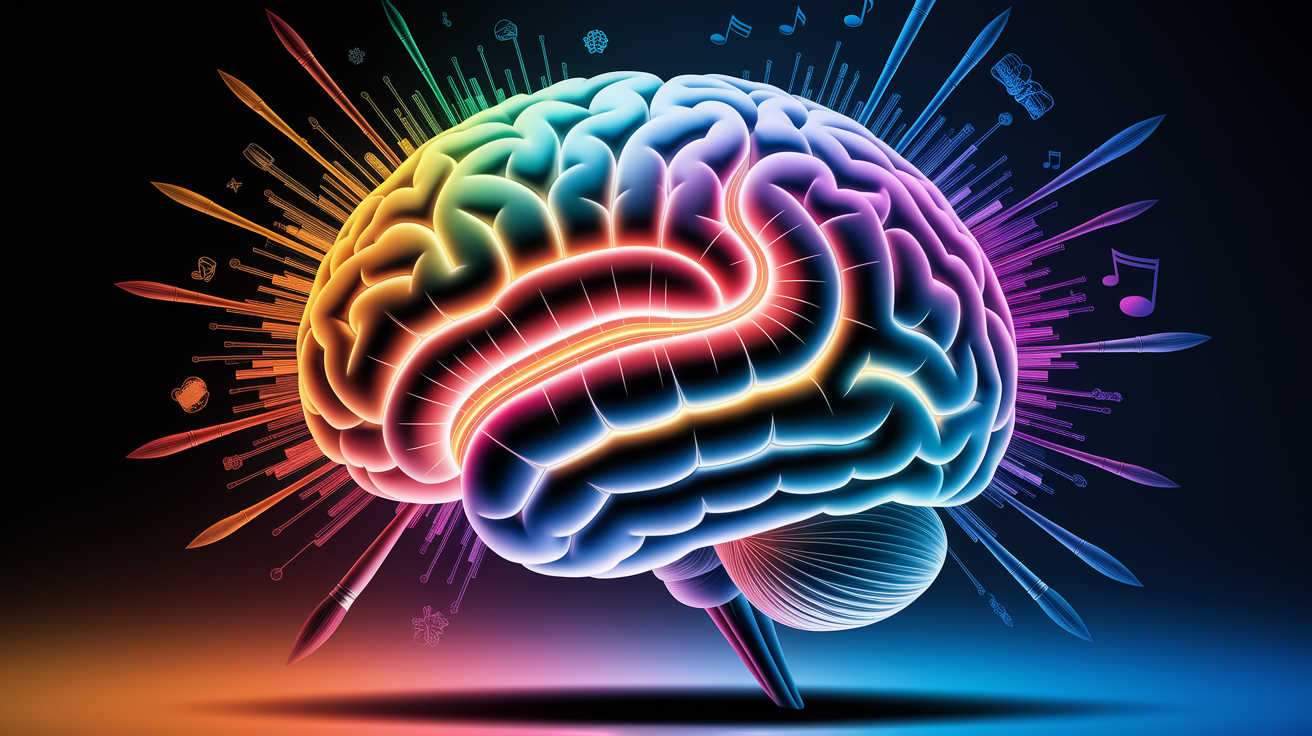
Meta-analyses of functional MRI studies reveal domain-specific activations across various cortical regions during creative tasks. Interestingly, creativity training programs appear to increase connectivity between brain regions like the medial prefrontal cortex (mPFC) and middle temporal gyrus (MTG), correlating with improvements in originality scores on creative tasks.
The balance of these neurochemical systems helps explain individual differences in creative abilities and may account for observations that certain altered states of consciousness—whether through meditation, sleep states, or even certain clinical conditions—can sometimes enhance creative output by temporarily shifting these neurochemical balances.
Conclusion: Embracing the Creative Mind
The neuroscience of creativity reveals that innovative thinking emerges from the coordinated activity of multiple brain networks, with the prefrontal cortex orchestrating a dynamic balance between spontaneous idea generation and focused evaluation. The hippocampus bridges past experiences with novel futures, while neurotransmitter systems modulate the flexibility and persistence necessary for creative breakthroughs.
Understanding these neural mechanisms not only satisfies our curiosity about how the brain generates new ideas but also offers potential pathways to enhance creative capacities through targeted interventions. As research in this field continues to evolve, we gain deeper insights into one of humanity’s most valued cognitive abilities—the capacity to think creatively and solve problems in innovative ways.
By embracing both the science and the art of creativity, we move closer to unlocking the full creative potential of the human mind.